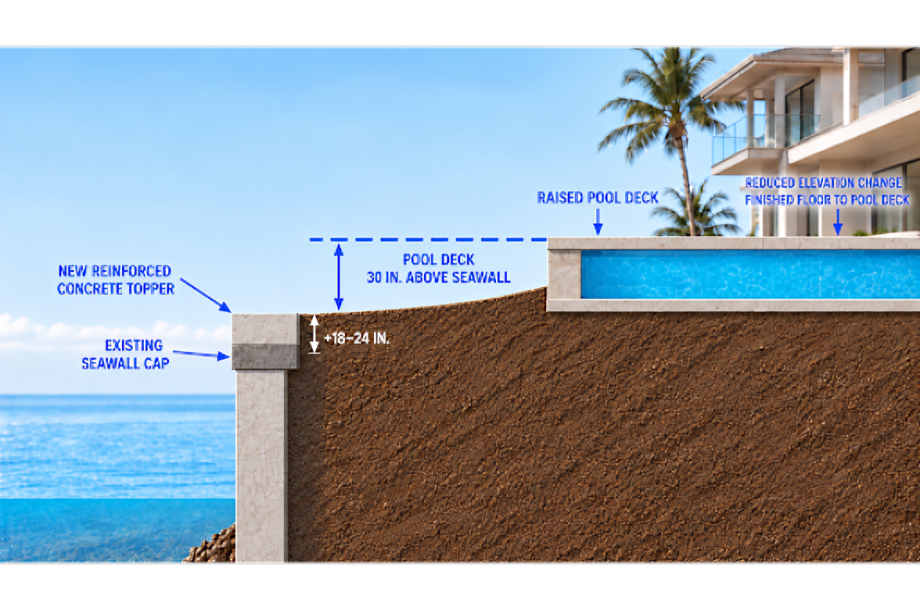

The Code Changed. Your Seawall Cap Can Go Much Higher Without Having To Replace Your Seawall.
Here’s What That Means for Your Waterfront Property.
Waterfront homeowners in Sarasota are unaware there’s an important development worth understanding: Sarasota, Longboat Key, Bird Key, Lido Key and Siesta Key have all recently increased the maximum permitted height for residential seawalls. In many instances, by over two feet!
Depending on the condition of your existing wall, this change means the affordable seawall fix for your property isn’t a traditional full replacement. A seawall cap topper will effectively raise the height of your seawall by as much as two feet or more. Raising your seawall cap gets you:
- Real protection from storm surge and unusual high tides.
- Stronger resale and insurability with your property set at the current maximum standard
- Peace of mind knowing your property isn’t the lowest point on the block
- A process that’s relatively quick and a fraction of the cost of full seawall replacement
- Protect your pool equipment and landscaping.
Here’s what to look for, what changed, why it matters, and what your options are.
Signs Your Sarasota Seawall Needs Repair and Which Fix It Actually Needs
Before deciding between a patch repair, a cap raise, or full replacement, it helps to know what you’re actually dealing with. Common signs a Sarasota seawall needs attention include:
- Cracking, spalling, or exposed rebar along the concrete cap
- Soil or sand loss behind the wall
- Water regularly overtopping the wall
- A visibly lower seawall than neighboring properties
- Settling, tilting, or visible separation at the wall’s base
Which of these you’re seeing determines which fix makes sense. Significant deterioration, tieback failure, or structural separation point to a full seawall replacement: the wall itself can no longer be trusted to do its job. But if your seawall is structurally sound and the main issue is that it’s simply too low (water overtopping it, or it visibly sitting lower than the seawalls next door) a full rebuild isn’t necessary. A seawall cap raise accomplishes the same goal for a fraction of the cost, and it addresses a cause that a standard repair wouldn’t touch: the height standard itself has changed, so a like-for-like repair would only bring your wall back to a standard that’s already outdated.
A Seawall Elevation Assessment is the fastest way to know which situation you’re in before you spend money on a repair that may not solve the actual problem.
What Changed With Sarasota Seawall Height Requirements
In 2024, the Town of Longboat Key increased the maximum allowable seawall height from 4.5 feet NAVD88 to 6.0 feet NAVD88.
In 2025, the City of Sarasota changed its code as well to account for future sea level rise and flooding resilience. The City of Sarasota new maximum top of seawall standard is 7.27 feet NAVD88. Previously, seawalls/bulkheads on most waterfront properties within the city limits were limited to 5 feet above Mean Low Water (MLW). For most Sarasota property owners the change in standard can convert to an approximate 18 – 24 inches of additional allowable seawall height.
In practical terms: even a well-maintained, structurally sound seawall may now sit well below what a property is legally entitled to. A newly built seawall next door or across the canal could be two feet or more taller, even under the same current code.
Why 2 Feet Makes a Bigger Difference Than It Sounds
It’s real storm protection. Recent hurricane seasons pushed water over Sarasota-area seawalls by just a few inches in some neighborhoods, enough to fill pools with silt, destroy landscaping, and ruin pool equipment that costs thousands of dollars to replace. A higher cap solves this at the source, keeping the water out rather than repairing the damage after it gets in.
It protects you from your neighbors’ decisions and vice versa. When a neighboring Sarasota property raises its seawall, water and erosion during a high-water event will naturally funnel toward whichever property sits lowest. Raising your own cap is how you make sure that’s not you.
It supports resale value. A Sarasota property finished at the current maximum permitted grade is more resilient, easier to insure, and a stronger story to tell a future buyer than one built to a now-outdated standard.
Everything built behind your seawall depends on it. Florida building code caps your pool deck elevation at 30 inches above your seawall cap, so every inch you add to the wall becomes an inch of design freedom for your pool, your patio, and your outdoor living space. For Sarasota homeowners planning new construction or a major renovation, raising the seawall cap before finalizing the site plan can open up options a lower cap simply doesn’t allow.
How Seawall Cap Raises Work
You don’t need to replace your entire seawall to take advantage of the new height limits. In most cases, a structurally sound existing wall can be raised with an engineered concrete cap, sometimes called a “topper”, that ties directly into your existing seawall.
The process:
Step 1: Seawall Elevation Assessment. Our team visits your property, evaluates your existing wall, and tells you approximately how many inches you can gain, including a preliminary estimate at no cost and with no obligation.
Step 2: Engineering & permitting. A licensed engineer evaluates your existing wall’s structural capacity and tiebacks to confirm it can support the additional weight, then provides signed and sealed engineering plans which we take to permitting. This typically takes 6–8 weeks before construction begins.
Step 3: The cap raise. Steel-reinforced, cast-in-place concrete is tied into your existing cap per engineers specs. Done well, a visible seam is the only sign the wall wasn’t always this height.
What a Higher Seawall Makes Possible for Your Sarasota Property
A seawall cap topper puts a few new options on the table:
- A bigger, more flexible site plan, if you’re building new or renovating, more elevation to design your pool deck, patio, and outdoor living space
- The freedom to raise your dock or boat lift to match your new seawall height, rather than being boxed in by the old one. Your current dock and lift can be raised to match the new seawall cap height or we can provide a simple cost effective solution to transition from the higher seawall to your existing dock.
Frequently asked Questions
Do I need a full seawall replacement, or will a cap raise work?
It depends on your wall’s structural condition. If your existing seawall is sound but simply below the new height standard, a cap raise is typically all that’s needed. If there’s significant deterioration, tieback failure, or structural damage, a full replacement may be the right call. A Seawall Elevation Assessment will tell you which situation you’re in.
Will raising my seawall weaken it?
No. Every project starts with an engineer’s structural evaluation of your existing wall and tiebacks before any work is scoped. If your wall can’t safely support a cap raise, you’ll be told before you spend anything and a full replacement would be the recommended path instead.
Will raising my seawall push water onto my neighbor's property?
A raised wall protects your property; it doesn’t redirect water onto a neighbor’s land. A proper drainage plan is a part of the engineering process. That said, neighbors sometimes have questions about drainage or how the change affects their own view or grading, and it’s worth having that conversation proactively if you’re doing work near a shared property line. We are happy to speak to them on your behalf.
What does a seawall cap raise cost in Sarasota, and how long does it take?
Most seawall topper projects start around $300 linear foot dependent upon seawalls length, width, and desired elevation increase. Engineering and permitting typically take 6–8 weeks, with the full process, start to finished installation, around three months.
Do I need to be planning new construction to benefit from this?
No. Established homeowners who are happy with their current home don’t need to build anything new to benefit. A cap raise on its own improves flood protection, resale value, and insurability. It becomes especially valuable if you’re planning a renovation or new build, since it also raises what your architect can do with the site.
How do I find out how many inches my Sarasota property can gain?
The only way to know for certain is a property-specific assessment, since it depends on your wall’s current height, the local code in your municipality, and your wall’s structural condition. The engineering process will determine the maximum height.
Find Out What Your Property Qualifies For
The rules changed in your favor. The only question is whether you’ve claimed it yet. A complimentary Seawall Elevation Assessment will tell you approximately how many inches your property can gain, with no cost and no obligation.
Or call 941.845.6077 to speak with our team directly.